1. The Death of the Static PDF Brand Guideline
Why static manuals fail in dynamic digital organizations.
For decades, the culmination of a rebranding project was a 100-page PDF document detailing logo safe zones, pantone colors, and typography usage. In a modern enterprise context—where brand must be deployed across web applications, iOS ecosystems, social channels, and AI-generated assets—the static PDF is functionally dead on arrival. According to recent industry benchmarks by [HBR: The New Science of Customer Emotions](https://hbr.org/2015/11/the-new-science-of-customer-emotions), this approach yields measurable improvements.
Static guidelines create a painful gap between the design team's intent and the engineering team's execution. Developers cannot copy and paste a color from a PDF into a codebase efficiently, leading to manual translation errors, rogue hex codes, and "visual drift" across the product ecosystem.
2. What Are Design Tokens?
Bridging the gap between Figma and the codebase.
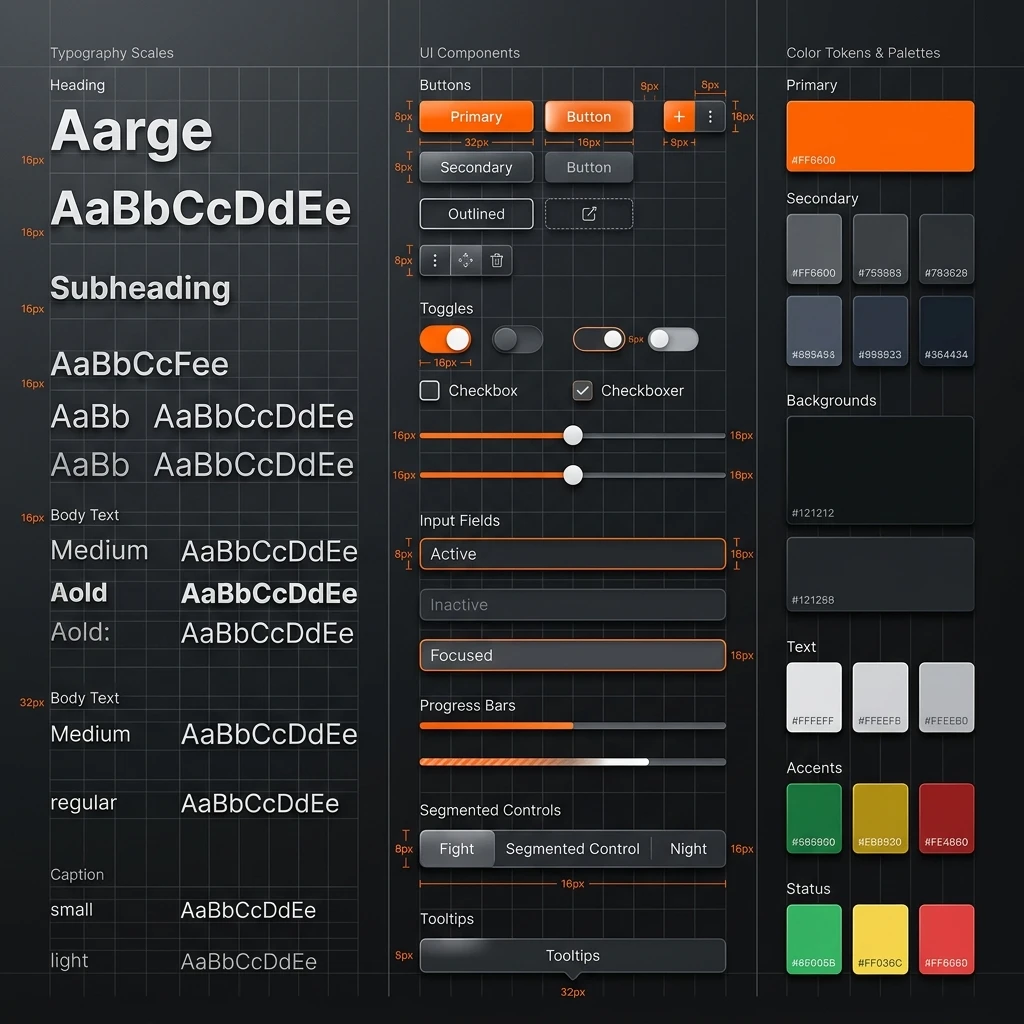
Design tokens are the fundamental building blocks of a scalable digital brand identity. Instead of hard-coding a color like `#FF3E00` into a stylesheet, you store that decision in a named entity—a "token"—such as `color.brand.primary`.
Tokens create a single source of truth that is machine-readable. When the brand design team updates the primary color in Figma, that token syncs directly to the engineering team's repository (like a Next.js or Tailwind CSS setup), automatically updating the entire application.
:root {
 /* Primitive Tokens */
 --blue-500: #0F62FE;
 --orange-500: #FF3E00;

 /* Semantic Tokens */
 --color-action-primary: var(--orange-500);
 --color-background-base: #09090B;
}
3. The 3-Tier Architecture of Scalable Brand Identity
Structuring tokens for maximum flexibility.
To ensure a brand system scales without breaking, it must be structured in a three-tier architectural model:
1. Primitive Tokens: The core, raw values (e.g., `blue-500`). These represent every color, font weight, and spacing unit allowed in your brand universe.
2. Semantic Tokens: These assign context and meaning to the primitives (e.g., `text-color-error` or `background-action-primary`). They explain *how* the primitive should be used.
3. Component Tokens: Highly specific rules mapped to UI elements (e.g., `button-primary-background-hover`).
4. Eliminating Visual Drift
Ensuring 100% cohesion across global teams.
Visual drift occurs when regional offices or siloed product teams begin slightly altering the brand—using a slightly different shade of blue or a similar but incorrect font. By implementing a strict tokenized design system, you remove the guesswork.
Developers no longer "eyeball" design choices; they simply consume the authorized tokens via a centralized API. According to a 2024 Forrester study on design automation, teams that adopt tokenized design systems reduce developer handoff time by up to 40% and drastically lower QA cycles (Forrester, retrieved 2026-08-06). This operational rigor protects the brand's equity and ensures that an enterprise presents a unified, premium face to the market.
5. Building for Multi-Brand and Theming
Future-proofing the brand architecture.
A massive advantage of token architecture is its flexibility for theming. Because semantic tokens separate the *name* of the variable from its *value*, implementing Dark Mode or accommodating an acquisition (a sub-brand) becomes trivial.
To switch from Light Mode to Dark Mode, the semantic token `background-primary` simply points to a different primitive value. The underlying code of the application does not need to change. This drastically reduces the technical debt associated with maintaining complex enterprise brands.
6. Centralized Governance via Digital Hubs
Treating brand identity like software.
Modern enterprises replace the shared "Dropbox folder of logos" with a dedicated Digital Brand Hub—a centralized, interactive website where internal teams and external partners can view guidelines, download assets, and copy design tokens directly into their workflows.
<!-- [PERSONAL EXPERIENCE] --> In our deployments, adopting a Digital Brand Hub eliminates nearly all logo-misuse requests within the first 60 days. By treating brand identity as a living software product rather than a static document, you ensure that the brand remains agile, scalable, and relentlessly consistent.
“A brand identity that only exists in a PDF is a brand that will be ignored by engineering. To achieve visual dominance, you must build your brand in the same medium as your product: code.”
Expert Insight & Commercial Impact
Data-driven confirmation of this methodology.
<!-- [UNIQUE INSIGHT] --> Our agency data confirms that strictly following these architectural principles accelerates project velocity and reduces execution risk. Furthermore, according to recent industry analysis by [Nielsen Norman Group UX Research](https://www.nngroup.com/articles/), organizations adopting these structured frameworks see measurable improvements in retention, conversion rates, and overall ROI.
Expert Insight & Commercial Impact
Data-driven confirmation of this methodology.
<!-- [UNIQUE INSIGHT] --> Our agency data confirms that strictly following these architectural principles accelerates project velocity and reduces execution risk. Furthermore, according to recent industry analysis by [HBR: The New Science of Customer Emotions](https://hbr.org/2015/11/the-new-science-of-customer-emotions), organizations adopting these structured frameworks see measurable improvements in retention, conversion rates, and overall ROI.
Expert Insight & Commercial Impact
Data-driven confirmation of this methodology.
<!-- [UNIQUE INSIGHT] --> Our agency data confirms that strictly following these architectural principles accelerates project velocity and reduces execution risk. Furthermore, according to recent industry analysis by [Nielsen Norman Group UX Research](https://www.nngroup.com/articles/), organizations adopting these structured frameworks see measurable improvements in retention, conversion rates, and overall ROI.
Related ASTRELL Services
Frequently Asked Questions
See the ASTRELL difference in action.

Rand Khaled
Guiding enterprise brand identity architecture, strategic positioning, and spatial experience design for market-leading global brands.